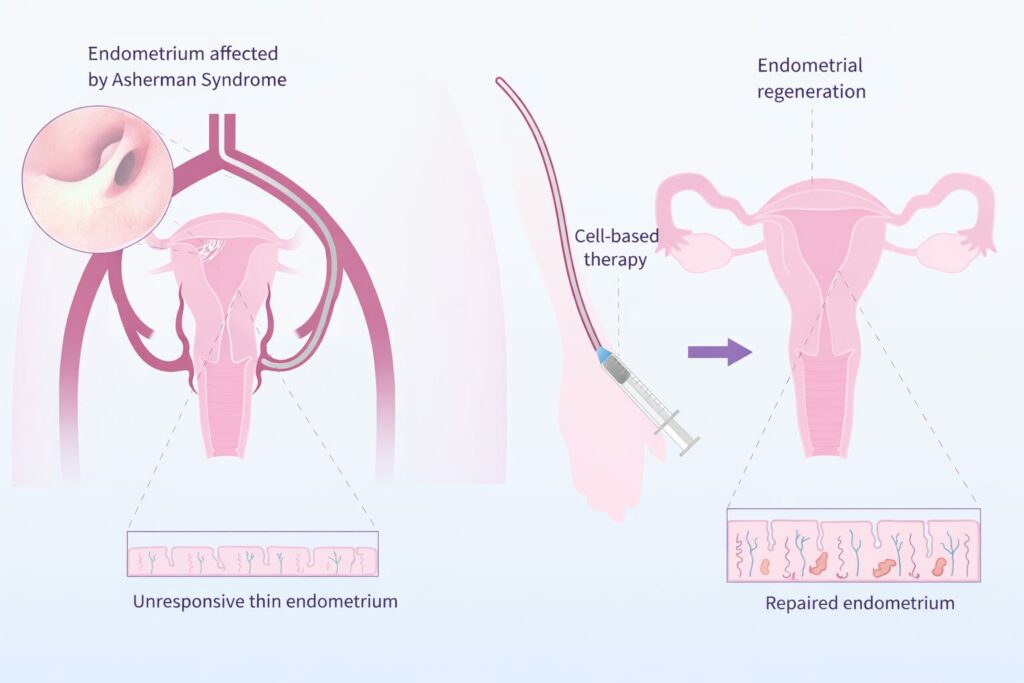
Severe endometrial damage — such as moderate to severe Asherman syndrome or persistent thin endometrium — remains one of the most difficult conditions in reproductive medicine.
In these patients, the basal layer of the endometrium is compromised, vascularization is reduced, and the tissue loses its regenerative capacity. Conventional surgical and hormonal treatments often provide only temporary improvement, with high recurrence rates and limited restoration of true biological function.
True recovery requires more than structural correction — it requires regeneration.
What is PAULA Cell Therapy?
PAULA (Patient-specific AUtologous endometriaL Advanced therapy) Cell Therapy is a regenerative treatment developed by Endorenew based on the intrauterine administration of autologous CD133+ stem cells.
These bone marrow–derived progenitor cells are processed under a rigorous clinical protocol to promote:
Angiogenesis
Cellular repair
Tissue remodeling
Functional endometrial recovery
By targeting the underlying regenerative deficit, PAULA Therapy aims to rebuild the biological foundation required for implantation.
Mechanism of Action
Restoring the Endometrial Environment
CD133+ stem cells support vascular growth and tissue repair through paracrine signaling and regenerative activation.
Their administration contributes to:
Enhanced vascularization
Structural recovery
Improved endometrial thickness
Increased uterine receptivity
Unlike conventional treatments, PAULA Therapy addresses the cellular and vascular basis of dysfunction.
Persistent thin endometrium unresponsive to conventional treatment
Repeated implantation failure linked to endometrial dysfunction
Each case is evaluated under strict clinical criteria to ensure appropriate patient selection.
Why PAULA Cell Therapy?
Autologous approach — minimal immunological risk
Regenerative mechanism — not merely corrective
Reduced recurrence risk
Outpatient, minimally invasive procedure
Developed under rigorous scientific and regulatory standards
PAULA Cell Therapy represents a shift in reproductive medicine:
From structural correction
→ To biological restoration
From temporary improvement
→ To regenerative repair
From recurrence
→ To rebuilding function
Therapy Process
The PAULA therapy process includes these steps:
Initial diagnostic hysteroscopy to confirm eligibility for therapy.
Administration of granulocyte colony-stimulating factor (G-CSF) to mobilize CD133+ stem cells into the bloodstream.
Apheresis to collect the mobilized CD133+ stem cells from the blood.
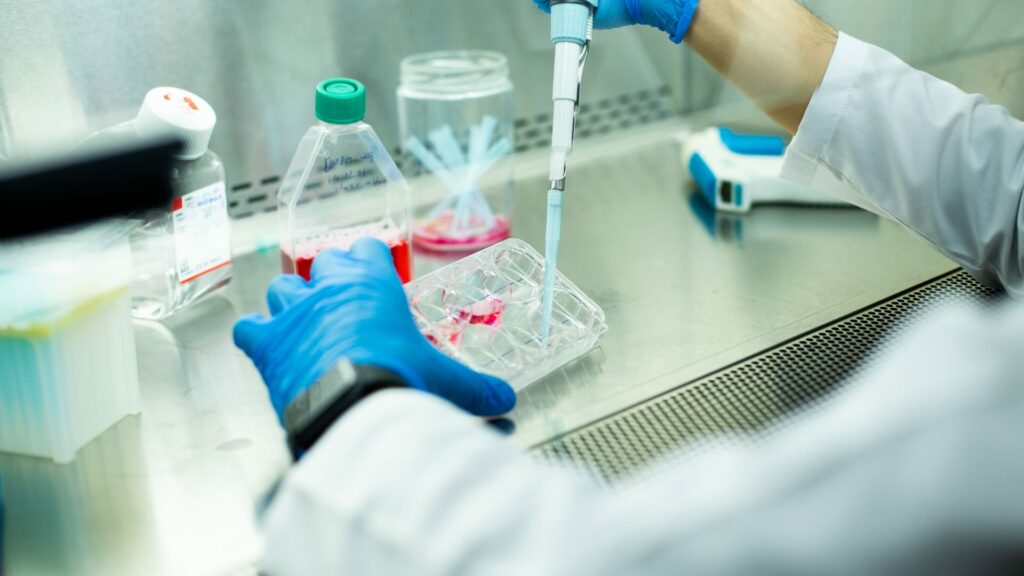
Preparation and enrichment of the stem cells in a Good Manufacturing Practice (GMP)-certified lab.
Infusion of the enriched stem cells into the uterine arteries via catheterization to promote endometrial regeneration.
Clinical Experience
Phase I/II treated 20 patients showing increased endometrial thickness, improved uterine cavity conditions, restored regular menstrual cycles, and successful pregnancies. Endorenew will conduct a Phase III trial planned for mid-2026 in Europe to consolidate these findings.
Safety and Efficacy
PAULA has been tested in clinical trials with promising results. The therapy is safe and effective, with patients experiencing minimal side effects. The use of autologous stem cells reduces the risk of immune reactions, ensuring compatibility and improving overall therapy outcomes.
Benefits
PAULA has shown proven results in clinical trials, demonstrating significant improvements in endometrial thickness, restoration of menstrual function, and positive fertility outcomes. The therapy is well-tolerated with no major adverse effects reported.
Manage consent
To provide the best experiences, we use technologies such as cookies to store and/or access device information. Consent to these technologies will allow us to process data such as browsing behaviour or unique identifiers on this site. Not consenting or withdrawing consent may adversely affect certain features and functions.
Functional
Siempre activo
Technical storage or access is strictly necessary for the legitimate purpose of enabling the use of a specific service explicitly requested by the subscriber or user, or for the sole purpose of carrying out the transmission of a communication over an electronic communications network.
Preferencias
El almacenamiento o acceso técnico es necesario para la finalidad legítima de almacenar preferencias no solicitadas por el abonado o usuario.
Statistics
El almacenamiento o acceso técnico que es utilizado exclusivamente con fines estadísticos.Technical storage or access used exclusively for anonymous statistical purposes. Without a request, voluntary compliance by your Internet service provider, or additional records from a third party, information stored or retrieved solely for this purpose cannot be used to identify you.
Marketing
Technical storage or access is necessary to create user profiles for sending advertising, or to track the user on a website or across several websites for similar marketing purposes.